Hacking Through the Holidays: My Advent of Cyber 2025 Experience
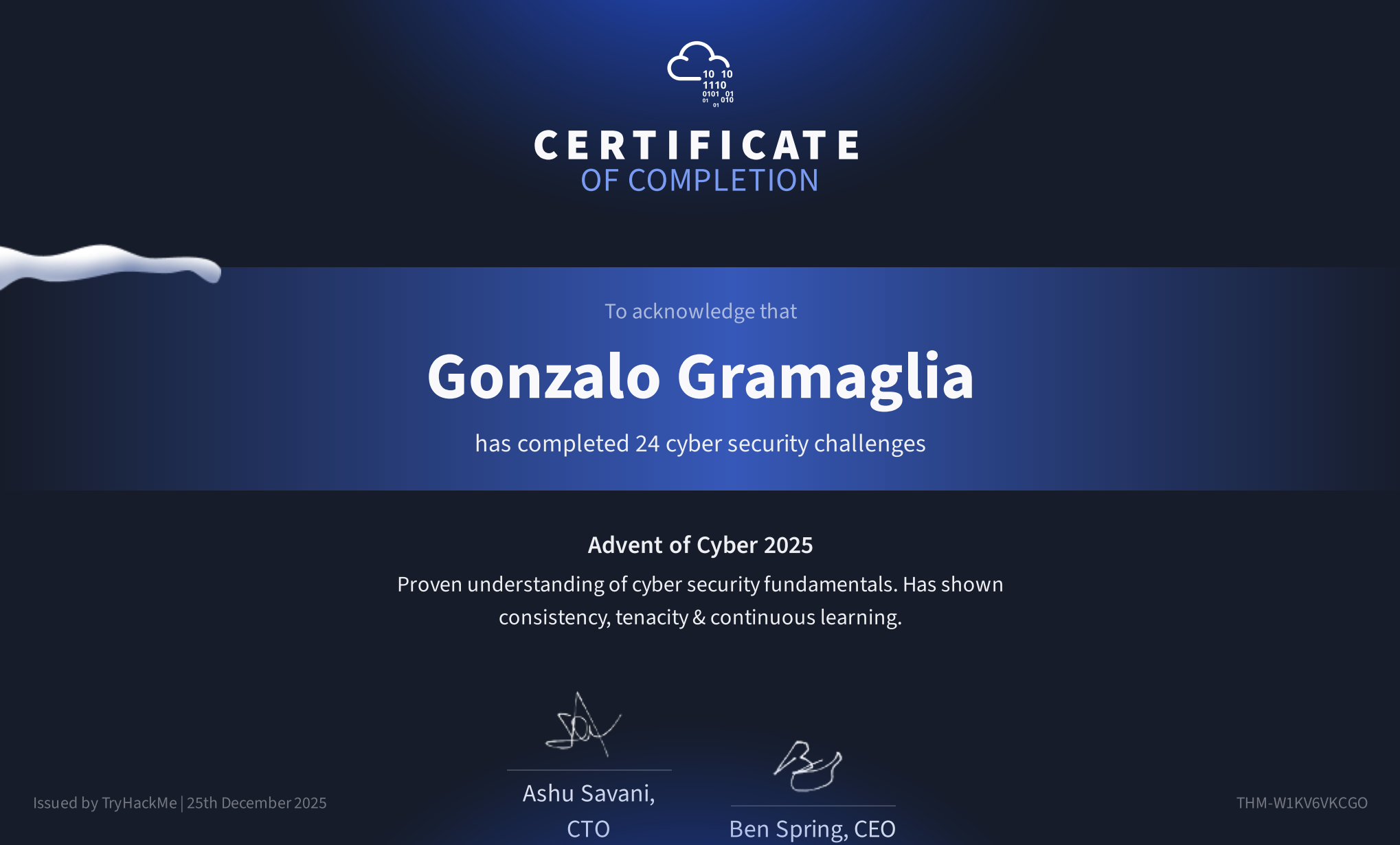
Christmas has come early for cybersecurity enthusiasts! This year I've joined TryHackMe's Advent of Cyber 2025, an annual event offering daily security challenges for 24 days. It's a fantastic opportunity to learn new skills, brush up on fundamental concepts, and of course, do some hacking while enjoying the holidays!
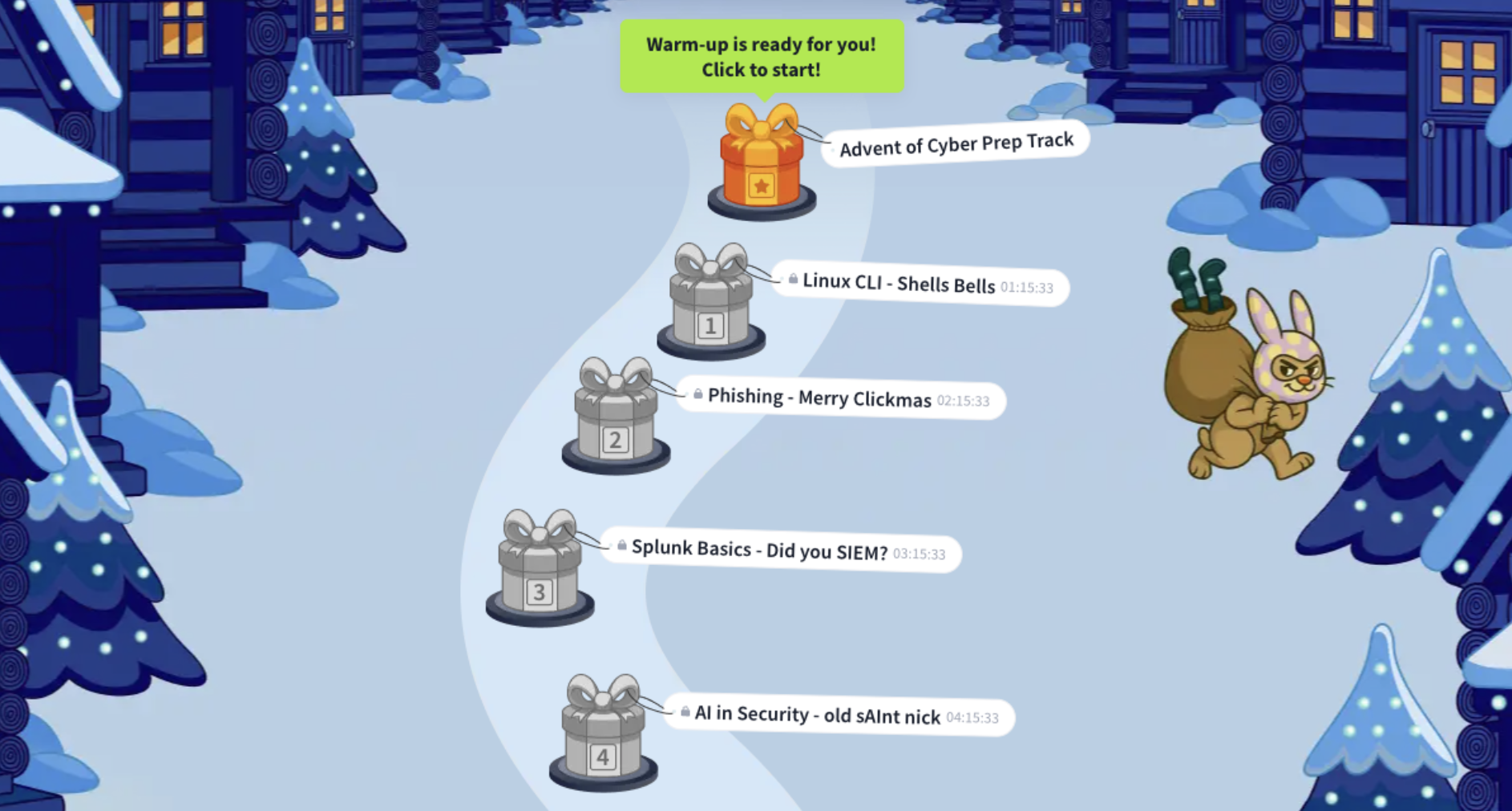
Here I will be sharing my progress and what I learn in each challenge.
Challenge Navigator
0) Advent of Cyber Prep Track
Before the main event started, I completed the "Prep Track". It was a series of warm-up tasks designed to get beginners ready (and refresh the memory of veterans) for what's coming. It covered essential basic concepts to ensure everyone is ready for the daily challenges.
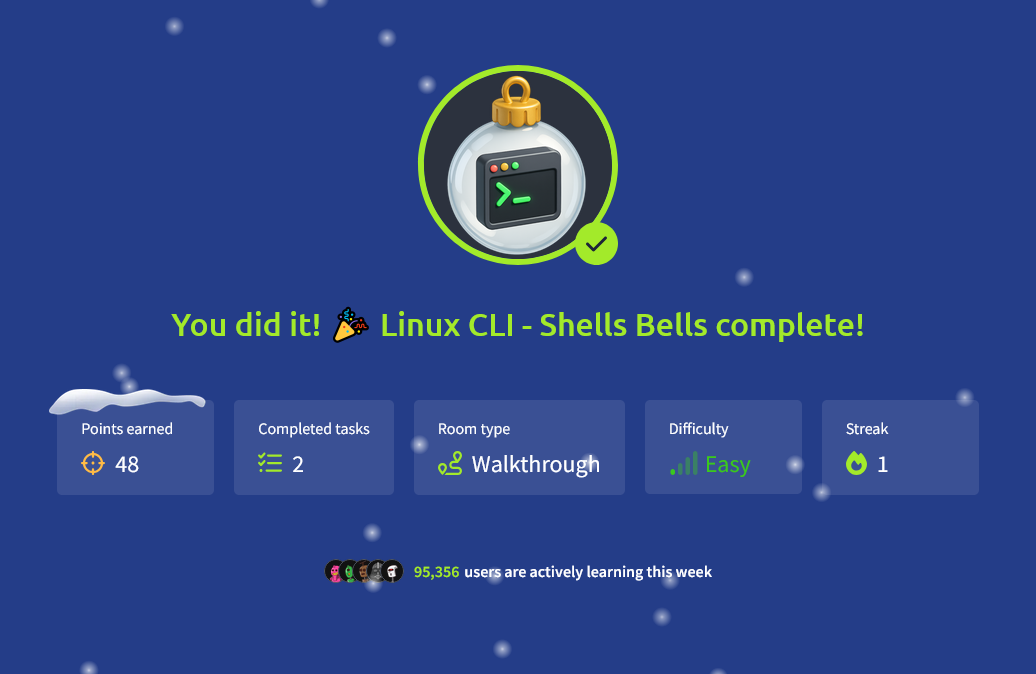
1) Linux CLI - Shells Bells
Topic: Introduction to the Linux Command Line.
Day 1 started with the basics but fundamental: the Linux terminal. "Shells Bells" took us to explore the command-line interface (CLI), learning how to navigate the file system, manipulate files, and use essential commands. It was an excellent reminder of why Linux is the operating system par excellence in cybersecurity.
2) Phishing - Merry Clickmas
Topic: Social Engineering and Phishing.
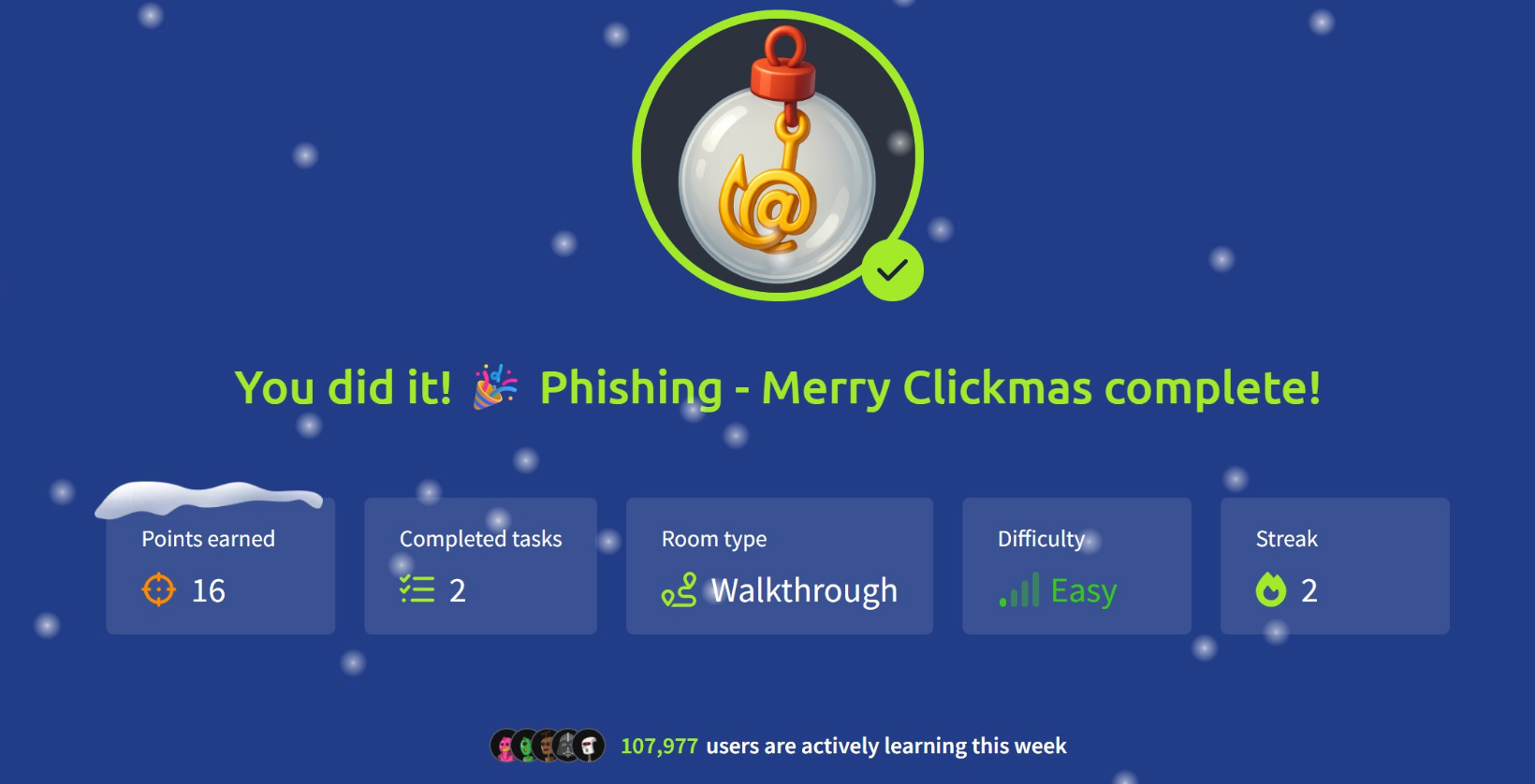
Day 2 got interesting with "Merry Clickmas". We learned how to use the Social-Engineer Toolkit (SET) to simulate phishing attacks. The challenge demonstrated how easy it can be to trick users into handing over their credentials and the importance of always being alert to suspicious emails.
3) Splunk Basics - Did you SIEM?
Topic: Log Monitoring and Analysis with Splunk.
On day 3, we delved into the world of defense (Blue Team) with "Did you SIEM?". We learned to ingest and parse custom logs using Splunk, one of the most popular SIEM (Security Information and Event Management) tools. It was great to see how suspicious activities can be detected by analyzing large volumes of data.
4) AI in Security - old sAInt nick
Topic: Artificial Intelligence in Cybersecurity.
Day 4, "old sAInt nick", showed us the power of AI. We explored how artificial intelligence can be used both to attack and defend systems. It is fascinating (and a bit scary) to see how these technologies are reshaping the security landscape.
5) Web Security - It’s Dangerously Obvious, Really
Topic: Insecure Direct Object References (IDOR).
Day 5 focused on a critical web vulnerability: IDOR. We explored how attackers can access unauthorized data simply by manipulating parameters like user_id or packageID in a URL. The challenge demonstrated that even if references are encoded (e.g., Base64) or hashed, they can often be bypassed if the server lacks proper authorization checks. It was a great lesson on the difference between authentication ("who you are") and authorization ("what you are allowed to do").
6) Malware Analysis - Principles of Malware Analysis
Topic: Static and Dynamic Malware Analysis.
Day 6 introduced the fascinating world of Malware Analysis. We learned to distinguish between Static Analysis (examining the file without running it) using tools like PeStudio to check strings and hashes, and Dynamic Analysis (executing the malware in a safe sandbox) using Regshot and ProcMon to observe its behavior, such as registry changes and system interactions. We practiced these techniques on a sample named HopHelper.exe to understand its malicious actions.
7) Network Discovery - Scan-ta Clause
Topic: Network Scanning and Enumeration.
Day 7 took us back to the basics of reconnaissance. We used Nmap to scan a network, identify active hosts, open ports, and running services. It was a practical exercise in understanding how attackers map out a target infrastructure and why visibility is crucial for defenders.
8) Prompt Injection - Sched-yule Conflict
Topic: Exploiting AI and LLMs.
On Day 8, we explored a modern vulnerability: Prompt Injection. We interacted with an AI agent and learned how to craft specific inputs to bypass its safety filters and make it reveal sensitive information or perform unauthorized actions. It highlighted the new attack surface introduced by integrating LLMs into applications.
9) Passwords - A Cracking Christmas
Topic: Password Cracking and Encryption.
Day 9 was all about breaking into encrypted files. We analyzed a protected ZIP file and used John the Ripper to perform a dictionary attack against its hash. This challenge reinforced the importance of strong, complex passwords and showed how easily weak encryption keys can be brute-forced.
10) SOC Alert Triaging - Tinsel Triage
Topic: Blue Team Operations and Log Analysis.
Day 10 put us in the shoes of a SOC Analyst. We used Microsoft Sentinel to investigate security alerts, filter out false positives, and correlate events to identify a true compromise. It was a great hands-on experience with a cloud-native SIEM and the decision-making process involved in incident response.
11) XSS - Merry XSSMas
Topic: Cross-Site Scripting (XSS).
Day 11 focused on web application security, specifically Reflected XSS. We learned how to inject malicious JavaScript into a vulnerable website to execute code in the victim's browser. The challenge demonstrated the mechanics of the attack and how to secure inputs to prevent it.
12) Phishing - Phishmas Greetings
Topic: Email Analysis and Phishing Detection.
Day 12 returned to the most common attack vector: Phishing. We analyzed suspicious emails to identify indicators of compromise (IOCs) like spoofed headers, malicious attachments, and deceptive links. It was a solid refresher on distinguishing legitimate communications from social engineering attempts.
13) YARA Rules - YARA mean one!
Topic: Malware Detection with YARA.
On Day 13, we learned to write YARA rules to detect malware based on patterns rather than just hash matching. We created custom rules to identify malicious files by searching for specific strings and byte sequences, a powerful technique for hunting threats that change their signature.
14) Containers - DoorDasher's Demise
Topic: Docker and Container Security.
Day 14 introduced us to the world of containers. We explored the structure of a Docker image, investigated its layers to find hidden secrets, and learned about common misconfigurations that can lead to container escape or privilege escalation. It was an essential lesson on securing modern microservices architectures.
15) Web Attack Forensics - Drone Alone
Topic: Analyzing Web Server Logs with Splunk.
Day 15 focused on Web Attack Forensics. We used Splunk to analyze web server logs, identifying traces of a command injection attack. By correlating IP addresses, user agents, and suspicious payloads, we were able to reconstruct the attacker's actions and understand the impact of the breach.
16) Forensics - Registry Furensics
Topic: Windows Registry Forensics.
Day 16 dove into the Windows Registry, a goldmine for forensic investigators. We learned how to use tools like Registry Explorer to uncover evidence of malicious persistence, tracking software installation dates, and identifying recently executed programs to piece together the timeline of an infection.
17) CyberChef - Hoperation Save McSkidy
Topic: Decoding and Reversing with CyberChef.
Day 17 introduced us to CyberChef, the "Cyber Swiss Army Knife." We practiced decoding various encoding schemes (Base64, Hex, ROT13) and reversing obfuscated data to reveal hidden flags. It was a great exercise in data manipulation and understanding how attackers hide their tracks.
18) Obfuscation - The Egg Shell File
Topic: Obfuscation and Deobfuscation.
Day 18 challenged us to unravel the secrets hidden within a suspicious PowerShell script found in a phishing email. We explored the concepts of Obfuscation, distinguishing it from encryption and encoding. Using CyberChef, we deobfuscated the script to reveal its true intent, learning how attackers hide their malicious code to bypass security filters.
19) ICS/Modbus - Claus for Concern
Topic: Industrial Control Systems (ICS) and Modbus.
Day 19 took a turn into the physical world with Industrial Control Systems (ICS). We investigated a compromised drone delivery system where gifts were being swapped for eggs! The challenge involved analyzing the Modbus protocol, understanding how PLCs (Programmable Logic Controllers) and SCADA systems communicate, and identifying the malicious commands that disrupted the operation.
20) Race Conditions - Toy to The World
Topic: Race Conditions in Web Applications.
On Day 20, we explored a timing-based vulnerability known as a Race Condition. We attempted to buy a limited-edition toy from an online store and discovered that by sending simultaneous requests, we could manipulate the stock count and purchase more items than allowed. It was a practical demonstration of concurrency issues and how to prevent them using atomic transactions.
21) Malware Analysis - Malhare.exe
Topic: Reverse Engineering and HTA Analysis.
Day 21 brought us back to Malware Analysis, this time focusing on a malicious HTA (HTML Application) file disguised as a "Developer Survey". We analyzed the Malhare.exe / HTA payload, decoding obfuscated strings (Base64, ROT13) to understand how it exfiltrated system information like the computer name and username to an external server.
22) C2 Detection - Command & Carol
Topic: Command and Control (C2) Detection with RITA.
Day 22 focused on Threat Hunting and detecting Command and Control (C2) beacons. We analyzed network traffic (PCAP) converted into Zeek logs. Using RITA (Real Intelligence Threat Analytics), we identified patterns of beaconing activity, helping us uncover a compromised host communicating with an external attacker server.
23) AWS Security - S3cret Santa
Topic: Cloud Security and AWS Enumeration.
Day 23 took us to the cloud! We explored AWS (Amazon Web Services) security, specifically focusing on S3 buckets and IAM (Identity and Access Management). We learned how to use the AWS CLI to enumerate permissions, assume roles to escalate privileges, and access sensitive data stored in misconfigured storage buckets. It was a crucial lesson on the shared responsibility model and the importance of properly securing cloud resources.
24) Exploitation with cURL - Hoperation Eggsploit
Topic: Protocol Manipulation and Exploitation.
The final challenge, Day 24, was a grand finale involving cURL and protocol manipulation. We used cURL to interact with a communication system, manipulating MQTT messages to control a factory's machinery. It demonstrated how versatile command-line tools can be used for exploitation and the importance of validating all inputs, even in internal communication protocols.
And that's a wrap! I have successfully completed all 24 days of the Advent of Cyber 2025. It has been an incredible journey, covering a wide range of topics from basic Linux skills to advanced cloud security and malware analysis. I've learned a ton and I'm looking forward to applying these new skills in 2026. Happy Hacking and Happy Holidays!